
Quick Summary
This guide evaluates the quietest garage door opener options to help homeowners eliminate disruptive mechanical rattle and ceiling vibrations in adjacent living spaces. Wall-mount jackshaft units and DC-motor belt drives deliver the quietest performance, particularly when paired with ball-bearing nylon rollers and rubber isolation brackets to halt structure-borne sound. Readers will understand how to properly balance and soundproof their garage system, with Complete Garage Door Repair Fort Myers available to provide free estimates and professional installation of ultra-quiet models.
Quietest Garage Door Opener Options for a Quiet Home
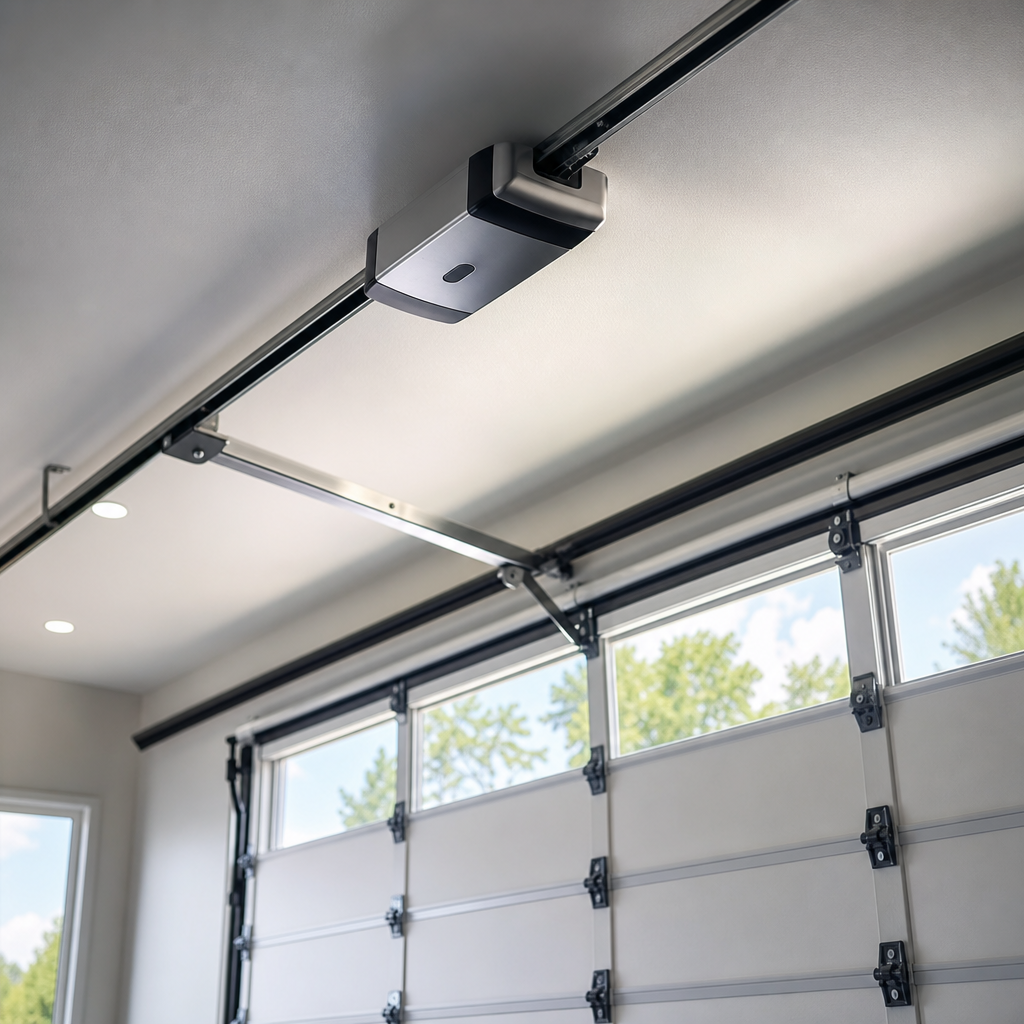
If you are researching the quietest garage door opener options, you probably already know the frustration of a loud opener. A noisy unit does not just make noise in the garage. It rattles drywall, vibrates through ceiling joists, and wakes up anyone sleeping in an adjacent or overhead bedroom.[2]
Replacing an old, clanking chain-drive system with a modern, very quiet unit transforms how your home feels. However, selecting the right model requires looking beyond motor decibel ratings on the box. Achieving very quiet operation comes from matching the right drive mechanism with smart vibration control.
The Quietest Drive Types Ranked
Garage door openers rely on different drive mechanisms to lift and lower the door. Here is how the primary drive types compare when quiet operation is your top priority.
1. Wall-Mount Jackshaft Openers
Wall-mount openers (often called jackshaft openers) are widely considered among the quietest options available. Instead of hanging from the ceiling and pulling the door along an overhead rail, a jackshaft unit mounts directly to the wall beside the garage door and turns the torsion spring shaft directly.
Because there is no overhead rail attached to your ceiling framing, physical motor vibrations never touch your ceiling joists. If you have a finished bedroom directly above the garage, a wall-mount jackshaft system eliminates the primary pathway for structural sound transfer.
2. DC-Motor Belt-Drive Openers
Belt-drive openers replace noisy steel roller chains with steel-reinforced polyurethane or rubber belts. Many models pair these belts with enclosed DC motors that ramp up and slow down gradually.
Belt drives eliminate metal-on-metal contact along the rail. According to Complete Garage Door Repair Fort Myers, when properly lubricated and tuned, a belt-drive opener produces little more than a low, quiet hum from several feet away. For standard ceiling configurations where a wall-mount unit might not fit, a belt-drive system is the best overall overhead choice.
3. Direct Drive Openers
Direct drive openers feature a stationary chain where the motor itself travels along the track to move the door. With only one moving part (the motor carriage), direct drive systems generate very little mechanical friction. While very quiet, they are generally on par with modern DC belt drives and slightly more expensive or harder to source replacement parts for in certain regions.
4. Chain-Drive Openers (The Loudest Option)
Traditional chain-drive openers rely on an exposed steel bicycle-style chain running over a metal rail. Every cycle creates metal-on-metal friction and cyclical slack clatter. While chain drives are economical and durable, they are not suitable for noise-sensitive installations.
Why Motor Decibels Are Only Half the Battle
Need quietest garage door opener options?
We’re available now — call for a fast, free estimate.
A common mistake homeowners make is buying an opener advertised as “whisper quiet,” only to install it and discover their living room still shakes when the door moves. That happens because an opener does not operate in a vacuum.
In regions with concrete block construction and wind-load building codes, such as Southwest Florida, garage doors are heavily reinforced. As Complete Garage Door Repair Fort Myers points out, double-layer steel doors equipped with heavy horizontal U-bars often weigh between 150 and 300 pounds. When that much weight rolls across steel tracks, small vibrations transfer straight into the building framing.[3]
Even the quietest motor will sound loud if:
- Standard steel rollers are grinding inside the tracks.
- Hanging brackets are bolted directly to ceiling joists without rubber isolation pads.
- The door springs are out of balance, forcing the opener to strain under heavy torque loads.
The Science of Vibration: Structural Coupling
Noise travels into your home along two paths: airborne sound (sound waves moving through the air) and structure-borne vibration (physical motion transferring into drywall and framing). In almost every noisy garage setup, structure-borne vibration is the real culprit.
A benchmark study by the National Research Council of Canada evaluated mechanical noise transfer from residential garage doors. The researchers found that isolating the tracks and mounting hardware from the building structure lowered average operating noise inside overhead living spaces by 7 to 13 dB(A). By reducing physical coupling, sound levels in overhead rooms dropped to roughly NC 25, which matches typical ambient background sound levels measured across roughly 600 residential homes.[1]
To achieve those numbers in your own home, combine a quiet motor with three hardware adjustments:
- Switch to nylon rollers: Replace stamped steel rollers with 13-ball-bearing, nylon-capped rollers to eliminate track rattle.
- Add vibration isolators: Install thick rubber isolation bushings between your ceiling framing and the opener’s metal drop brackets.
- Choose a soft-start DC motor: Motors that gently ramp up speed stop the sudden jolt that shakes the header plate at the beginning and end of each cycle.
Frequently Asked Questions
Which type of garage door opener is the quietest?
Wall-mount jackshaft openers and DC-powered belt-drive openers are the quietest options. Wall-mount models avoid ceiling contact altogether, while belt drives eliminate metal chain noise along the rail.
Is a belt drive opener quieter than a direct drive opener?
They operate at comparable noise levels. Both DC belt-drive and direct-drive units provide very quiet operation. Belt drives are generally more common, making replacement parts, accessories, and local service easier to find.
Are wall-mount jackshaft garage door openers very quiet?
The motor itself is very quiet. However, you will still hear the mechanical movement of the door panels, rollers, and hinges moving along the steel tracks. Pairing a jackshaft opener with sealed nylon rollers creates one of the quietest overall setups possible.
What is the best quiet garage door opener if there is a bedroom above the garage?
A wall-mount jackshaft opener is the top recommendation because it mounts beside the door on the wall rather than hanging from the ceiling below the bedroom floor. If your garage lacks the required side clearance, choose a very quiet belt-drive unit mounted with rubber vibration dampening brackets.
Why is my current garage door opener making so much vibrating noise?
Loud vibrations are usually caused by rigid metal-to-wood mounting, worn-out steel rollers, dry chain links, or loose hardware. If your door is poorly balanced due to weak or worn torsion springs, the motor has to work much harder, creating extra vibration throughout the frame.
How much does a quiet garage door opener cost to install?
As noted by Complete Garage Door Repair Fort Myers, the total cost depends on the drive type, model features, and local labor rates. Additional hardware upgrades, such as nylon rollers or vibration isolation brackets, can also affect overall installation expenses.
Need quietest garage door opener options?
We’re available now — call for a fast, free estimate.
Sources
- Reviewing Noise Analysis – Resources – Noise – Environment – FHWA – fhwa.dot.gov
- 17 Best Quiet Garage Door Openers for Attached Garages (September 2026) Expert Reviews – ACFC – acfc.org (2026)
- [PDF] R esearch Highlights – publications.gc.ca
Related reading: Best Smart Garage Door Opener Fort Myers – Call Now-10% Off – Same-Day Service – Free Estimate
Related reading: Liftmaster Garage Door Opener Reviews | 10% Off & Free Estimate | Same-Day Service
Frequently Asked Questions
What space requirements are needed to install a wall-mount jackshaft opener?
Wall-mount jackshaft openers typically require at least 8 inches of side room next to the vertical track and an accessible front-mount torsion spring shaft. If your garage lacks side clearance or uses extension springs, Complete Garage Door Repair Fort Myers can inspect your layout and install an ultra-quiet DC belt-drive model instead.
What motor size is required to keep heavy hurricane-rated garage doors quiet?
Heavy double-layer steel and wind-load doors generally require a 3/4 HP-equivalent or 1-1/4 HP-equivalent DC motor to prevent mechanical strain and rattling. Complete Garage Door Repair Fort Myers pairs high-torque DC motors with precisely balanced spring systems to guarantee smooth, low-decibel performance on heavy doors.
How often should a quiet garage door system be serviced to prevent noise buildup?
Hardware such as hinges and bearings should be lubricated every six months with a specialized non-greasy lubricant, keeping the belt itself clean and dry. Booking an annual tune-up with Complete Garage Door Repair Fort Myers ensures springs, nylon rollers, and rubber isolation brackets remain properly aligned for silent travel.
About the author
 |
Sarah Miller Sarah Miller is a technical writer specializing in home security and residential access systems, with a particular focus on garage door mechanisms. She holds a B.A. in Communications from Florida Gulf Coast University and has spent five years creating content for the home improvement and property management sectors in Southwest Florida. Her work translates complex mechanical concepts into clear, actionable advice for homeowners and property managers. |