
Quick Summary
Learning how to align garage door sensors resolves common safety-reversal malfunctions where an opener detects a false obstruction and refuses to close. Proper calibration involves cleaning the photo-eye lenses, ensuring brackets are mounted no higher than six inches from the floor, and adjusting sensor angles until the indicator lights shine steadily. Readers will be able to safely realign their photoelectric sensors using standard hand tools or recognize when to call Complete Garage Door Repair Fort Myers for same-day professional calibration.
How to Align Garage Door Sensors for Fast Safety Fixes
Learning how to align garage door sensors is a common way to fix a garage door that starts to close and then immediately reverses. When photo-eye sensors lose alignment, the opener assumes an obstruction is present and blocks the door from closing as a safety precaution.[1]
Federal safety standards require automatic residential garage door openers to include entrapment protection, such as photoelectric sensors, sensing edges, or equivalent devices, alongside an inherent reversing mechanism capable of reversing a moving door within two seconds. These sensors help provide entrapment protection. Note that the provided authoritative research does not establish a verified national percentage for failures caused by sensor misalignment. As recommended by Complete Garage Door Repair Fort Myers, the instructions in this guide serve as general guidance; always consult the opener and sensor manufacturer’s manual for model-specific procedures, indicator colors, tools, and tests.[2] See also Common Garage Door Problems and Solutions | Call Now-10% Off | Same-Day Service | Free Estimate.
Quick Diagnostic: What You Need to Align Garage Door Sensors
Safety sensors sit near floor level on either side of the garage door opening and project a beam across the path. Documented guidance specifies that sensors should be installed at a maximum mounting height of 6 inches from the floor.[3]
Key Takeaways
- General Guidance: Refer to your specific opener and sensor manufacturer’s manual for model-specific procedures, indicator colors, tools, and tests.
- Height and Position: Documented guidance specifies a maximum mounting height of 6 inches from the floor, pointing directly across the opening.
- Status Lights: Indicator-light colors vary by system. For example, documented Performax models use specific indicator lights, while other brands may differ. A steady light generally indicates proper alignment.
- Alignment Steps: Remove obstructions, clean photo-eye lenses with a soft dry cloth, adjust sensors until indicator lights are steady, and tighten the brackets.
Tools and Materials Required
- Standard screwdriver or wrench
- Tape measure
- Soft dry cloth
Step 1: Inspect the Sensor Indicator Lights
Before adjusting brackets, check the indicator lights on each sensor body. Indicator-light colors vary by system. For example, documented Performax systems use specific LED indicators, while other systems differ. Consult the opener and sensor manufacturer’s manual to determine the specific meanings of your system’s indicator lights.
| Indicator Light State | Probable Cause | Immediate Action |
|---|---|---|
| Solid / Steady | Normal sensor alignment | Sensors are aligned; consult manual if operational issues persist |
| Blinking, Flickering, or Unlit | Misalignment, dirty lens, or obstruction | Remove obstructions, clean photo-eye lenses with a soft dry cloth, and adjust sensors until indicator lights are steady |
Step 2: Clean the Photoelectric Lenses and Clear the Door Path
- Remove any objects or debris blocking the path between the sensors.
- Gently clean the photo-eye lenses on both units using a soft dry cloth.
- Check if the indicator lights turn steady after cleaning the lenses.
Step 3: Adjust the Mounting Brackets and Check Elevation
Need how to align garage door sensors?
We’re available now — call for a fast, free estimate.
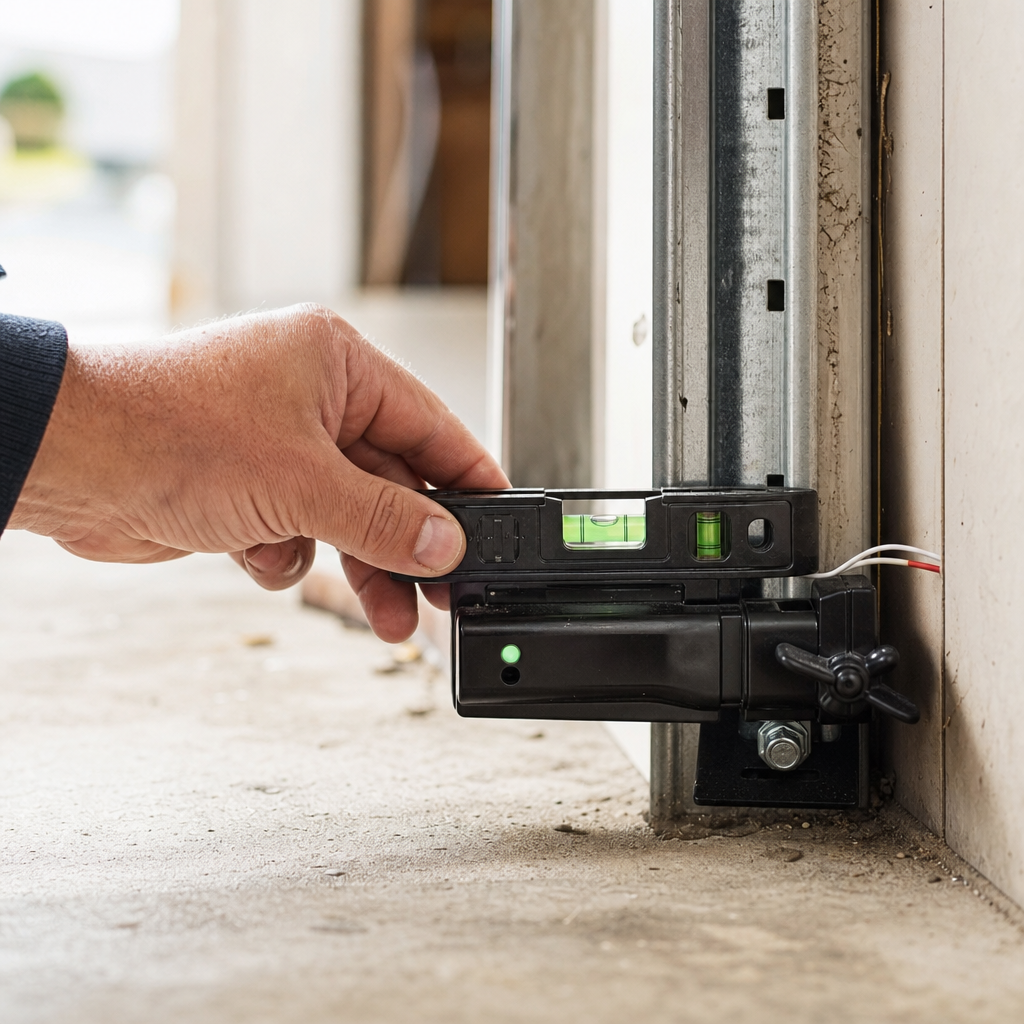
As noted by specialists at Complete Garage Door Repair Fort Myers, if the lenses are clean and the indicator lights are not steady, the sensors require alignment.[4]
- Verify Mounting Height: Confirm that the sensors comply with the documented guidance specifying a maximum mounting height of 6 inches from the floor.
- Loosen the Fasteners: Loosen the mounting fastener slightly to allow adjustment.
- Align the Sensors: Adjust the sensors until the indicator lights are steady.
- Tighten Hardware: Securely tighten the bracket fasteners while ensuring the indicator lights remain steady.
Step 4: Test the Safety-Reversal Function
The safety-reversal function must be tested safely after adjustment. Follow the opener manufacturer’s instructions for the specific testing procedures and requirements for your model.
Persistent Problems
If the sensors cannot be aligned, the indicator lights do not become steady, or the door continues to reverse improperly, seek qualified service from professionals like Complete Garage Door Repair Fort Myers for persistent problems.[5]
Frequently Asked Questions
What color lights should be on garage door sensors?
Indicator-light colors vary across manufacturers, though most standard systems use an amber sending light and a green receiving light that illuminates steadily when properly aligned.
What should I do if my garage door sensors do not work after alignment?
Ensure all obstructions are removed, clean the photo-eye lenses with a soft dry cloth, and confirm that the sensors are installed no higher than the maximum 6-inch mounting height specified in documented guidance. If indicator lights do not remain steady or problems persist, seek qualified service.
Need how to align garage door sensors?
We’re available now — call for a fast, free estimate.
Sources
- Update of Automatic Garage Door and Garage Door Openers Entrapment Incidents to Children under 15 Years of Age Reported to CPSC Between December 1, 1996 and June 30, 2003 – cpsc.gov (2003)
- 32566 – govinfo.gov (2018)
- PubMed Central (PMC) Home Page – pmc.ncbi.nlm.nih.gov
- blk_pdf_523 – cpsc.gov
- Comment on Safety Standard for Automatic Residential Garage Door Operators – law.resource.org
Related reading: Why Is My Garage Door Making a Grinding Noise – Call Now-10% Off – Same-Day Service – Free Estimate
Related reading: Garage Door Roller Replacement Service | Call Now-10% Off | Same-Day Service | Free Estimate
Related reading: Garage Door Panel Replacement Fort Myers | Call Now-10% Off | Same-Day Service | Free Estimate
Frequently Asked Questions
How can I tell if my garage door sensor is broken rather than just misaligned?
If a sensor light remains completely dark even when connected to power, or flickers continuously despite cleaning and manual repositioning, the issue usually stems from damaged low-voltage wiring or faulty internal components. When simple realignment fails to restore a steady indicator light, Complete Garage Door Repair Fort Myers can test the wiring circuits and replace failing sensors.
Can direct sunlight cause garage door sensors to malfunction?
Yes, intense sunlight shining directly into the receiving sensor's photo-eye can overwhelm the optical signal and trick the opener into sensing an obstruction. You can prevent sun glare issues by switching the positions of the sender and receiver units or installing a small sunshade around the receiving lens.
Why does my garage door safety sensor keep shifting out of alignment?
Frequent misalignment usually happens when operational track vibrations, loose bracket fasteners, or accidental bumps from vehicles and yard equipment nudge the sensor away from its target. If tightening the mounting bolts does not hold the sensors securely within the required six-inch floor height, the team at Complete Garage Door Repair Fort Myers can reinforce or replace damaged mounting brackets.
About the author
 |
Sarah Miller Sarah Miller is a technical writer specializing in home security and residential access systems, with a particular focus on garage door mechanisms. She holds a B.A. in Communications from Florida Gulf Coast University and has spent five years creating content for the home improvement and property management sectors in Southwest Florida. Her work translates complex mechanical concepts into clear, actionable advice for homeowners and property managers. |