
Quick Summary
Worn or damaged garage door seals allow wind-driven rain, outdoor heat, and pests into attached garages, leading to energy loss and property damage. Upgrading to durable EPDM synthetic rubber seals and perimeter weatherstripping provides critical protection against humidity and storms, with specialized solutions available from Complete Garage Door Repair Fort Myers. After reading, homeowners will understand how to spot seal failure, compare DIY versus professional installation costs, and request a free estimate to restore a tight weather barrier.
Garage Door Weather Seal Replacement: Reduce Drafts and Water Intrusion
When wind-driven rain, outdoor heat, or pests start creeping under your garage door, a prompt garage door weather seal replacement protects your home from unnecessary damage. Most homeowners notice the warning signs right away: daylight shining under the closed door, puddles forming after a typical storm, or rubber that has turned stiff and brittle. In a 1995 study of five homes under a 50 Pa pressure test conducted by the National Institute of Standards and Technology (NIST), attached garages averaged 48.4 air changes per hour compared to 9.6 in the main living quarters, though these figures do not isolate garage-door seal leakage. An unsealed garage can allow significant outdoor air and humidity into the space.[1]
As noted by specialists like Complete Garage Door Repair Fort Myers, replacing damaged weatherstripping restores a tighter seal along your concrete floor and door jambs without the expense of replacing the entire door.[5]
Costs and What to Expect During Replacement
According to industry cost guides, professional garage door weather seal replacement is estimated between $75 and $150 for a bottom seal, while a full-perimeter replacement (including top and side jambs) is estimated between $150 and $350, though actual prices vary. Final pricing depends on door width, the specific seal profile required, the condition of the track retainer, and whether any surrounding frame repairs are necessary.
What Is Included in Professional Service?
A complete weatherstripping service addresses both the threshold and the outer frame through several focused steps:
- Inspection and Tear-Out: Old, degraded rubber and vinyl are removed, and the retainer tracks are cleaned of accumulated grit, salt, and sand.
- Retainer Realignment: Technicians inspect the bottom aluminum channel, straightening pinched spots or replacing corroded tracks so the new seal seats evenly.
- Custom Sizing and Insertion: High-grade rubber is pulled through the track, trimmed with proper expansion margins, and secured at the ends.
- Threshold and Travel Calibration: When needed for proper door contact, garage door opener travel limits may be adjusted with appropriate safety precautions so the door closes snugly against uneven concrete without crushing the material.
Average Project Timelines and Energy Payback
Residential seal replacement timelines vary depending on the door condition, track alignment, and the specific materials installed. Energy savings from weatherstripping also vary by climate and building configuration; regional analysis has estimated annual electricity savings for certain weatherstripping interventions, though these figures do not apply specifically to garage-door seals alone.[3]
Why Garage Door Weatherstripping Fails
Weatherstripping performance and durability depend on climate, building conditions, seal type, and the intervention performed. Over time, daily compression cycles, exposure to the elements, and friction against the floor gradually contribute to seal wear and degradation.
Choosing the Best Weather Seal Materials
Need garage door weather seal replacement?
We’re available now — call for a fast, free estimate.
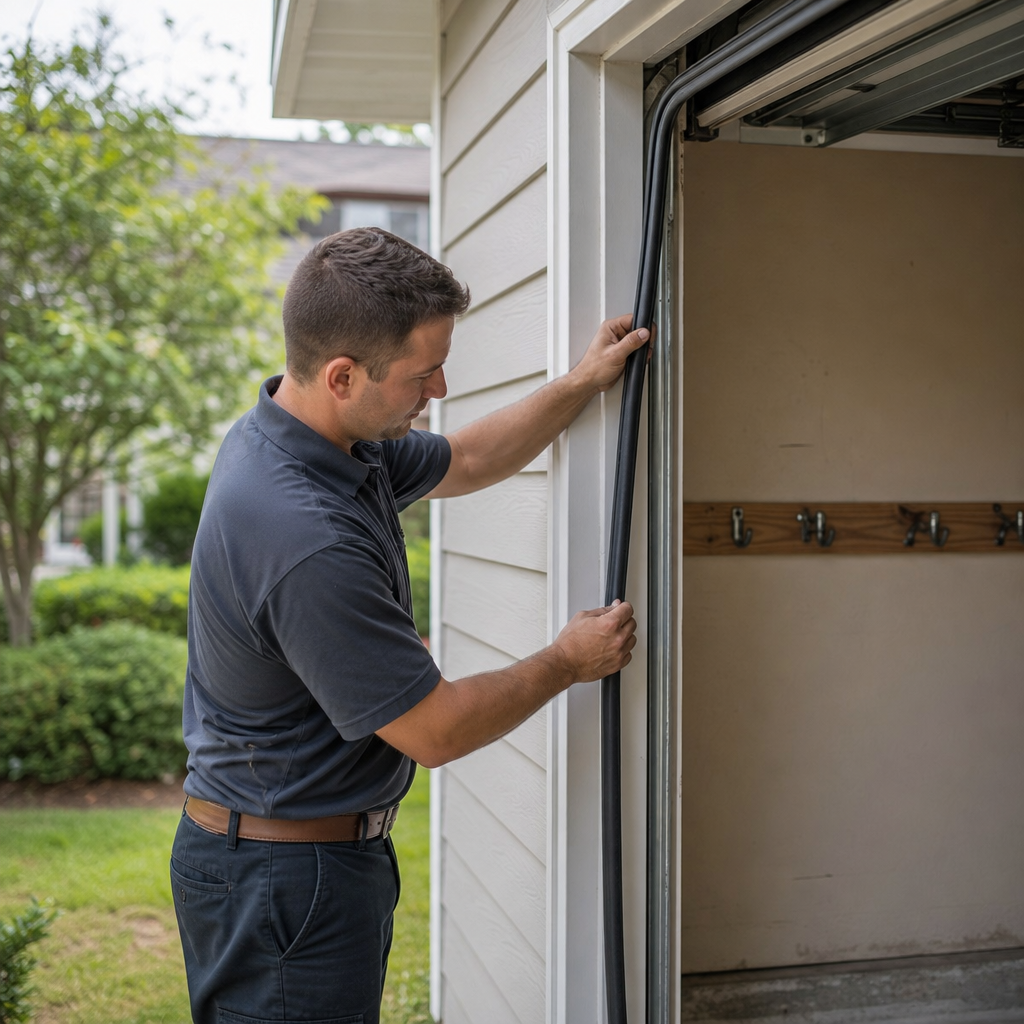
Picking the right material helps ensure your seal performs well under local conditions.
EPDM Synthetic Rubber vs. Standard Vinyl
Standard vinyl seals are often used in moderate environments. In hot, humid conditions such as those found in Florida, Complete Garage Door Repair Fort Myers points out that EPDM synthetic rubber is recommended to better maintain elasticity and resist degradation from heat and moisture.
Retainer Types and Bottom Profiles
Bottom seals come in several common profiles, including T-style, bulb, and U-channel designs. U-channel seals slide into a dual-track aluminum retainer and bow outward, creating a flexible cushion that conforms to dips and uneven spots in the concrete. If your door has a damaged or rusted bottom channel, upgrading to a heavy-duty aluminum retainer allows for wider, thicker rubber profiles.
Top and Side Jamb Perimeter Weatherstripping
Sealing the bottom of the door handles only part of the opening. The Michigan State University Extension guide estimates nearly 50 square inches of opening area for a 1/8-inch crack around an average single garage door. Installing perimeter stop molding along the top and side jambs helps close perimeter gaps around the edges of the panels.[4]
DIY vs. Professional Garage Door Bottom Seal Replacement
Homeowners comfortable with basic tools can often tackle a slide-in bottom seal replacement if the existing aluminum track is straight and rust-free. However, hiring a professional is the safer choice when dealing with damaged tracks, custom framing, or uneven slabs.
| Factor | DIY Installation | Professional Service |
|---|---|---|
| Retainer Prep | Works fine if the channel is straight, clean, and unbent | Technicians straighten, clean, or replace bent and corroded tracks |
| Safety Around Cables | Risk of accidentally loosening dangerous bottom corner brackets | Trained handling around high-tension counterbalance cables |
| Slab Fitment | Standard stock seals may leave gaps on cracked or sloped slabs | Custom seal sizing and conditional opener limit adjustments if needed for proper contact |
Common Pitfalls with Warped Retainers
One of the biggest headaches during a DIY repair is threading a new rubber seal into an old track. Over years of use, aluminum retainers get dinged, pinched, and caked with road debris. Forcing a flexible seal through a crimped track often tears the rubber before the installation is even finished. Technicians use track-widening tools and specialized lubricants to seat the seal smoothly without stretching or ripping it.
Safety Risks Near High-Tension Cables
The bottom seal retainer is fastened directly next to the lower corner brackets of the door. These brackets are under intense mechanical tension from the counterbalance springs and lift cables. Loosening the wrong bolt on a bottom corner bracket can cause the cable to release violently, creating an extreme safety hazard. If your bottom retainer requires structural replacement or bracket removal, a trained technician from a service like Complete Garage Door Repair Fort Myers should always handle the job.
Frequently Asked Questions About Garage Door Weather Seals
How much does professional garage door weather seal replacement cost?
According to industry cost guides, replacing just the bottom seal is estimated between $75 and $150, while a full-perimeter replacement covering the bottom, top, and both side jambs ranges from $150 to $350. Actual prices vary based on door dimensions, retainer condition, and labor rates.
How do I know when my garage door weatherstripping needs to be replaced?
Check the bottom and edges of your door during the day. If you see light coming through while the door is closed, feel air drafts, find standing water after rain, or notice that the rubber has cracked, flattened, or turned brittle, the seal is no longer doing its job.
Can I replace the bottom garage door seal myself or should I hire a professional?
You can handle the project yourself if the aluminum track is in good condition and uses a standard slide-in profile. Hire a professional if the track is bent, corroded, missing, or if the repair requires working near the high-tension bottom corner brackets.
What is the best weather seal material for hot and humid climates?
In hot and humid regions such as Florida, EPDM synthetic rubber is recommended because it maintains flexibility and holds up better against heat and moisture.
How long does a garage door weather seal typically last before cracking?
Seal lifespan varies depending on climate, material quality, exposure to sunlight and moisture, and door usage frequency.
How does proper weather sealing improve home energy efficiency?
Weatherstripping savings vary depending on climate and home construction. Regional analysis has estimated electricity savings for certain weatherstripping interventions on building envelopes by reducing unconditioned air leakage into adjacent structures.[2]
Need garage door weather seal replacement?
We’re available now — call for a fast, free estimate.
Sources
- [PDF] Update for Chapter 19 of the Exposure Factors Handbook – EPA – epa.gov (2004)
- Air and Pollutant Transport from Attached Garages to Residential … – tsapps.nist.gov (2002)
- An Evaluation of the Low-Income Weatherization Program – efis.psc.mo.gov (2008)
- [PDF] Weatherstripping – Energy Facts – Bay County – baycountymi.gov
- NY Standard Estimation Approach – it.dps.ny.gov
Frequently Asked Questions
How do you seal a garage door bottom against an uneven or cracked concrete floor?
For uneven concrete, technicians install an extra-wide U-channel EPDM rubber seal paired with a heavy-duty aluminum retainer to bridge low spots and dips. Specialists like Complete Garage Door Repair Fort Myers also recalibrate the opener travel limits or add a floor threshold seal to ensure a watertight seal across the entire slab.
How long does a professional garage door weather seal replacement appointment take?
A standard bottom seal or full-perimeter replacement typically takes between 45 to 90 minutes to complete. Technicians clean out the tracks, straighten or replace damaged retainers, slide in the custom-fit rubber, and test door closure during a single service visit.
What maintenance keeps new garage door weatherstripping from drying out in humid climates?
Wash the weatherstripping twice a year with warm, soapy water to remove grit and salt residue, then coat it with a silicone-based conditioner to maintain flexibility. Avoid petroleum-based lubricants or harsh solvents, which cause EPDM rubber and vinyl seals to degrade and crack prematurely.
About the author
 |
Sarah Miller Sarah Miller is a technical writer specializing in home security and residential access systems, with a particular focus on garage door mechanisms. She holds a B.A. in Communications from Florida Gulf Coast University and has spent five years creating content for the home improvement and property management sectors in Southwest Florida. Her work translates complex mechanical concepts into clear, actionable advice for homeowners and property managers. |